

🚨 Google’s “Hide Sponsored Results” Update (2025): How It’s Redefining SEO, Ads, and the Future of Organic Visibility

A Silent Revolution on the Search Page
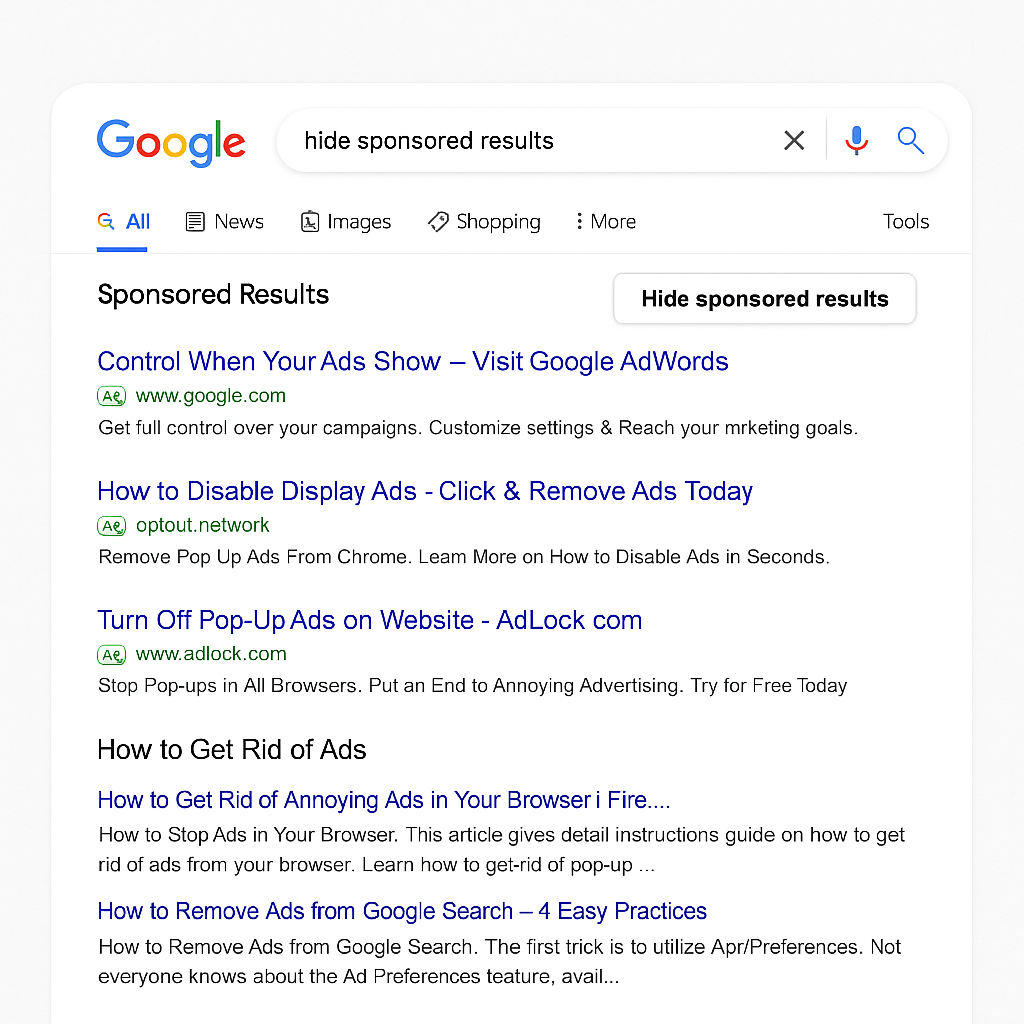
One quiet evening in October 2025, marketers around the world noticed something unusual on Google’s Search Engine Results Page (SERP). A small new label appeared above the ads section — “Sponsored Results” — along with a subtle toggle that said: “Hide sponsored results.”
No official announcement. No flashy blog post. Just a quiet experiment that could end up changing how billions of users interact with search.
If you’re thinking this sounds small, think again. This is one of those butterfly-effect changes that could reshape the balance between paid ads and organic visibility — just like when Google first introduced “Ad” labels in 2013 or switched to mobile-first indexing.
So, what does this “Hide Sponsored Results” update really mean? And how should marketers, SEOs, and advertisers prepare for what could be a new era of user control and organic dominance?
Let’s unpack it step by step.
What Exactly Changed: Google’s “Hide Sponsored Results” Explained
In this latest Google SERP update, all text ads are now grouped under one unified, clearly visible label — “Sponsored Results.”
That label stays sticky as you scroll, so users always know which section of the page contains paid listings. But the real twist is that users can now collapse or hide that entire section with a single click.
Essentially, users can now say:
“Show me only the organic results.”
This means, for the first time ever, Google is visually separating ads and organic listings in a way that puts power directly in users’ hands.
According to early reports from The Verge, Search Engine Journal, and 9to5Google, the rollout started globally in mid-October 2025 on both desktop and mobile. It’s part of Google’s larger push toward ad transparency and user trust.
But make no mistake — the implications go far beyond interface design.
Why Google Is Doing This: Transparency, Trust, and a New Business Model
To understand this update, you have to think like Google.
For years, the company has faced criticism over how similar ads and organic listings look. Regulators in both the EU and the US have pressed for clearer ad labeling. Users often couldn’t tell which results were paid.
This update is Google’s answer — a cleaner, more honest search experience.
But there’s more.
Think about YouTube Premium — Google already offers a paid, ad-free experience for video watchers. So what if Search is next?
This “Hide Sponsored Results” feature could be a testbed for a future ad-free Search subscription model.
Imagine a “Google Search Premium” that removes ads entirely in exchange for a monthly fee. It’s a move that would monetize both ends of the ecosystem — advertisers and users — just like YouTube already does successfully.
How This Impacts Advertisers: A New Reality for Paid Campaigns
For advertisers, this change could sting.
If users start regularly collapsing sponsored sections, ad impressions and click-through rates (CTR) could drop significantly — especially for competitive, high-CPC keywords.
Let’s look at what might happen next:
- Visibility drops: Users who hide sponsored results simply won’t see your ad, no matter your bid or ad quality.
- Auction pressure increases: Remaining ad slots become more expensive as advertisers fight for the limited “always-visible” users.
- Copy quality matters more: Transparent ad labeling means your ad copy must feel less like a pitch and more like a trusted recommendation.
- Diversification becomes critical: Relying solely on Google Ads is now risky — brands need strong organic and social presence.
In short, ads aren’t going away, but the balance of power is shifting.
How This Impacts SEO and Organic Marketers
Now here’s the good news: if you live and breathe SEO — this update is your moment.
When users hide sponsored results, organic listings take the front seat. That means:
✅ More scroll visibility for organic results
✅ Higher click-through rates on position 1–3 rankings
✅ More trust from users who consciously reject ads
This makes organic visibility more valuable than ever.
The marketers who’ll win are those who can combine EEAT (Experience, Expertise, Authoritativeness, Trustworthiness) with Helpful Content principles — not those who just chase keywords.
Here’s what you should focus on right now:
- Publish genuinely useful content — answer questions, show expertise, build topical depth.
- Use long-tail and intent-based keywords — like “how Google hide sponsored results affects SEO” or “organic SEO strategy after Google update.”
- Improve your on-page trust signals — author bios, source citations, internal linking, and schema markup.
- Optimize for user experience — fast load times, mobile responsiveness, and visual clarity.
This update rewards authenticity over ads. If users can hide ads, you can’t fake relevance anymore.
The New Line Between Paid Reach and Real Relevance
Google’s “Hide Sponsored Results” update blurs — and at the same time, sharpens — the line between paid and organic visibility.
In the past, marketers often debated: “Should we invest more in Google Ads or SEO?”
Now, the question becomes:
“How can we make our organic content so good that users choose to see it?”
This is the era where real relevance beats paid reach.
Brands that build trust through experience — product demos, real reviews, thought leadership — will dominate. Those who rely solely on ads will find themselves hidden, quite literally, behind a collapsed section.
What It Means for Affiliate, Publisher, and Coupon Websites
Let’s bring it home to a niche you know well — the affiliate and coupon space.
Coupon and deal websites often compete head-to-head with advertisers who run PPC campaigns on branded keywords.
But now, with users having the power to hide ads, high-authority coupon website like SavingHarbor can reclaim visibility they lost to paid listings.
That’s huge.
It means:
- Users searching for “Amazon promo code” or “Nike coupon” could now see organic coupon listings first, not paid ads.
- Trust signals and authenticity (like verified coupons, timestamps, and reviews) will drive click-throughs.
- Affiliate marketers who invest in SEO will outperform those relying on PPC bidding.
In simple terms:
If users hide ads, affiliates who build trust win.
This update could spark the next big wave of organic-first affiliate growth.
Predictions: Where Google Search Is Heading Next
Let’s look ahead.
This “Hide Sponsored Results” feature is not a random experiment — it’s part of a larger shift toward personalized, transparent, AI-assisted search experiences.
Expect these trends to follow:
- Premium, ad-free Search tier: Users might soon pay a small subscription to enjoy cleaner, ad-free search experiences — similar to YouTube Premium.
- AI summaries replace some ads: As AI overviews expand, organic content feeding those summaries will matter even more.
- Higher organic CTRs: If ads are collapsible, top organic listings could see 10–20% CTR growth in 2025–2026.
- Increased content competition: As brands pivot to organic SEO, the bar for “helpful” content will rise.
So, don’t just chase algorithms — build brand equity through trust and storytelling.
Strategic Takeaways: How to Adapt Right Now
Here’s your action checklist as a marketer, SEO, or business owner:
✅ Audit your ad dependency — what % of your traffic is paid vs organic?
✅ Invest in organic authority — content depth, topical clusters, and high EEAT.
✅ Monitor SERP behavior — use tools like Ahrefs, Rank Ranger, or manual spot-checks to see how often the “Hide Ads” option appears.
✅ Strengthen your content strategy — use long-tail keywords like:
- how Google’s hide sponsored results affects SEO
- Google ad transparency update explained
- organic SEO strategy after Google update
- ✅ Plan for AEO (Answer Engine Optimization) — your content should be AI-readable, concise, and fact-based so tools like Perplexity, ChatGPT, and Gemini can surface it.
The content that AI tools pick up and cite in their answers tends to be:
- Informative and structured
- Authored by real experts
- Trustworthy and well-linked
- Non-promotional
Follow that formula, and you won’t just rank — you’ll be referenced.
Conclusion: The Future of Visibility Is Organic
Google’s “Hide Sponsored Results” feature marks a turning point.
For years, the battle between paid vs organic has been about budget. Now, it’s about user choice.
If people can literally hide your ads, your brand’s long-term success depends on whether your organic content is worth seeing.
The winners of this new era will be those who combine technical excellence, authentic storytelling, and trust-driven SEO.
Because when ads can vanish, only truth, trust, and value remain.
🌍 Explore the Future of Search, SEO, and User Trust
Want to see what the future of transparent, SEO-driven digital experiences looks like?
Visit our latest project — SavingHarbor.com — a platform built around speed, trust, and real-world performance.
Few Frequently Asked Question By the Users
1. What is Google’s “Hide Sponsored Results” feature?
Google’s “Hide Sponsored Results” is a new SERP feature that allows users to collapse or hide all sponsored (paid) listings on the search results page. It gives users more control over what they see — focusing only on organic results if they choose.
2. When did Google start testing the “Hide Sponsored Results” feature?
The feature began rolling out quietly in October 2025, first appearing for select users worldwide. It’s currently in testing, with global rollout expected to expand through late 2025 and early 2026.
3. Why did Google introduce this change?
Google introduced this update to increase transparency and user trust. Regulators have long criticized how similar ads look to organic results. By clearly labeling and allowing users to hide ads, Google improves the user experience and complies with ad disclosure requirements.
4. How does this update affect advertisers?
Advertisers may see lower impressions and CTR if users choose to hide sponsored results. This makes ad copy quality, bidding strategies, and ad placements more important than ever.
5. Will Google ads disappear entirely if users hide them?
No — ads will still exist. Users who click “Hide Sponsored Results” will only hide the ad block temporarily. Google’s ad auction and campaign systems remain active, but visibility depends on user preferences.
6. How does this impact SEO and organic visibility?
This update significantly increases the value of organic SEO. When ads are hidden, organic listings move higher on the page, gaining more clicks, visibility, and trust from users who prefer non-sponsored results.
7. What keywords should marketers focus on after this update?
Focus on intent-driven and long-tail keywords, such as:
- “how Google hide sponsored results affects SEO”
- “Google SERP update 2025”
- “organic vs paid results Google”
- “SEO trends 2025”
These help you capture organic traffic from users researching the change.
8. Will this feature affect affiliate or coupon websites?
Yes — positively. If users hide ads, organic coupon and deal pages gain better visibility. This benefits trusted sites with verified offers, strong SEO, and clear content structures like SavingHarbor.com or GenieCoupon.com.
9. Could this lead to an ad-free Google Search subscription?
It’s possible. Google already offers ad-free experiences on YouTube Premium. Many experts believe this SERP update could pave the way for a “Google Search Premium” subscription that removes ads entirely.
10. How can brands prepare for this update?
Brands should strengthen their organic and content marketing efforts:
- Invest in EEAT-driven content
- Build trust through transparency
- Optimize technical SEO and schema
- Reduce dependency on paid-only strategies
11. What does this mean for the future of Google Ads?
Google Ads will remain important, but advertisers must adapt. Expect higher competition for visible ad spots and a stronger focus on creative, trustworthy ad copy that blends relevance with credibility.
12. Will this update affect click-through rates (CTR)?
Yes. Early predictions suggest that CTR on organic listings could increase by 10–20%, while CTR on sponsored results might decline, depending on how often users hide the ad block.
13. How does this align with Google’s Helpful Content Update?
Perfectly. The “Hide Sponsored Results” feature supports Google’s ongoing shift toward Helpful, human-first content. It rewards authentic, experience-driven websites and discourages low-quality, keyword-stuffed pages.
14. How can publishers get their content cited by AI tools like ChatGPT or Perplexity?
To appear in AI results, your content must be:
- Structured, factual, and easy to parse
- Authored by a credible expert
- Free of clickbait or fluff
- Marked with proper schema and meta data
- This helps AI models index and quote your content as a reliable source.
15. What’s the key takeaway from this update?
The future of visibility belongs to trustworthy organic content.
If users can hide ads, they’ll gravitate toward results that offer real value. The “Hide Sponsored Results” feature proves that authenticity, authority, and experience are the new currency of online visibility.